

Transcript
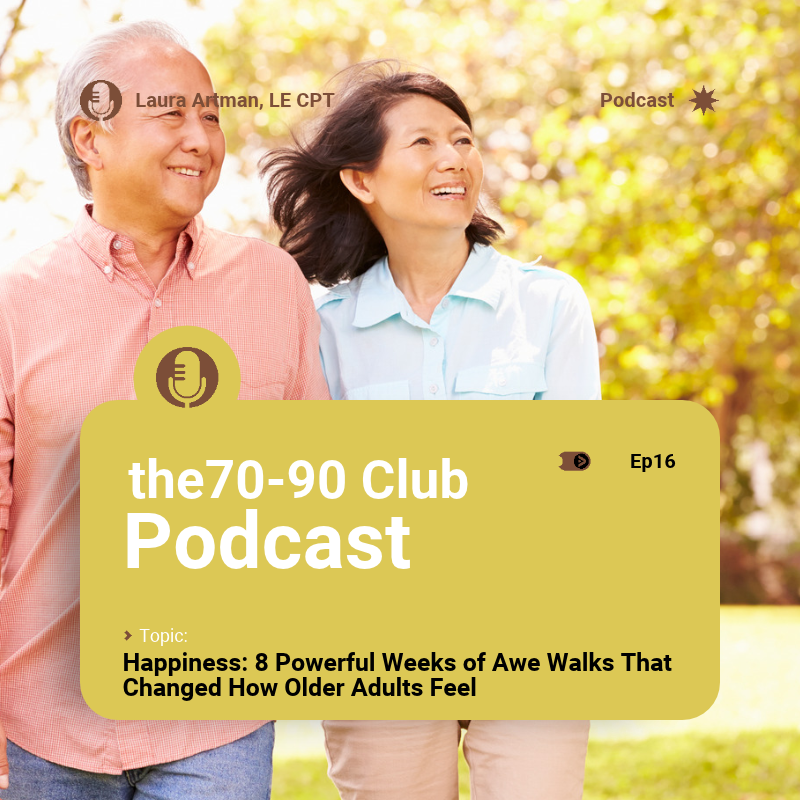
Welcome to the 70–90 Club podcast. This is Laura Artman and today I’m talking about happiness, and the power of awe.
Here is a study I love. Researchers at UCSF, along with Dacher Keltner of UC Berkeley, asked a simple question. Could awe raise happiness in older adults?
Awe is the feeling you get in the presence of something vast, something you can’t fully understand. It can come from nature, art, music, or being part of a ceremony. Researchers say awe takes the focus off ourselves and brings us closer to other people. They call it the small self. A healthy sense of how you fit into the bigger picture.
Here is what they did. Sixty healthy older adults took one fifteen-minute walk outdoors, once a week, for eight weeks. That’s eight walks. Half of them were taught about awe and asked to look for it while they walked. The other half just walked.
On every walk, each person took a photo of themselves and rated how they felt. And every day, they reported their emotions outside of the walk too.
Here is what happened to happiness. The awe walkers reported more joy. They felt more compassion and more gratitude. As the weeks went by, they took up less and less of the frame in their own photos. The small self, showing up on camera. And their smiles got bigger. The researchers measured that too, from the faces in the photos.
And it didn’t stop when the walk ended. In their daily lives, the awe walkers reported bigger increases in compassion and gratitude, and bigger drops in distress, than the group that just walked. Ordinary days felt different.
Both groups walked. The difference was awe. Looking outward, at something larger than themselves, changed the happiness those participants felt.
Now, a fair word on the study. It was sixty healthy older adults, so larger studies will help confirm it. But the results pointed the same way in the walks, in the photos, and in the daily reports.
So here is your assignment. Fifteen minutes. Outdoors. Once this week. Before you go, remind yourself what awe is. Then look for it. A big sky. An old tree. A long view. You decide what is vast to you. Movement and happiness belong together.
Thank you for listening. Join the conversation using hashtag 70-90-fitness. Contact Laura Artman Certified Personal Trainer to learn more. Laura Artman dot com. once again that is Laura Artman dot com
- Sturm VE, Datta S, Roy ARK, Sible IJ, Kosik EL, Veziris CR, Chow TE, Morris NA, Neuhaus J, Kramer JH, Miller BL, Holley SR, Keltner D. Big smile, small self: awe walks promote prosocial positive emotions in older adults. Emotion. 2022;22(5):1044–1058. https://pubmed.ncbi.nlm.nih.gov/32955293/
- Sturm et al., full text (author manuscript). https://pmc.ncbi.nlm.nih.gov/articles/PMC8034841
- UCSF News. “‘Awe Walks’ Boost Emotional Well-Being.” September 2020. https://www.ucsf.edu/news/2020/09/418551/awe-walks-boost-emotional-well-being
Related Posts









Transcript
Welcome to the 70–90 Club podcast. This is Laura Artman and today I’m talking about happiness, and the power of awe.
Here is a study I love. Researchers at UCSF, along with Dacher Keltner of UC Berkeley, asked a simple question. Could awe raise happiness in older adults?
Awe is the feeling you get in the presence of something vast, something you can’t fully understand. It can come from nature, art, music, or being part of a ceremony. Researchers say awe takes the focus off ourselves and brings us closer to other people. They call it the small self. A healthy sense of how you fit into the bigger picture.
Here is what they did. Sixty healthy older adults took one fifteen-minute walk outdoors, once a week, for eight weeks. That’s eight walks. Half of them were taught about awe and asked to look for it while they walked. The other half just walked.
On every walk, each person took a photo of themselves and rated how they felt. And every day, they reported their emotions outside of the walk too.
Here is what happened to happiness. The awe walkers reported more joy. They felt more compassion and more gratitude. As the weeks went by, they took up less and less of the frame in their own photos. The small self, showing up on camera. And their smiles got bigger. The researchers measured that too, from the faces in the photos.
And it didn’t stop when the walk ended. In their daily lives, the awe walkers reported bigger increases in compassion and gratitude, and bigger drops in distress, than the group that just walked. Ordinary days felt different.
Both groups walked. The difference was awe. Looking outward, at something larger than themselves, changed the happiness those participants felt.
Now, a fair word on the study. It was sixty healthy older adults, so larger studies will help confirm it. But the results pointed the same way in the walks, in the photos, and in the daily reports.
So here is your assignment. Fifteen minutes. Outdoors. Once this week. Before you go, remind yourself what awe is. Then look for it. A big sky. An old tree. A long view. You decide what is vast to you. Movement and happiness belong together.
Thank you for listening. Join the conversation using hashtag 70-90-fitness. Contact Laura Artman Certified Personal Trainer to learn more. Laura Artman dot com. once again that is Laura Artman dot com
- Sturm VE, Datta S, Roy ARK, Sible IJ, Kosik EL, Veziris CR, Chow TE, Morris NA, Neuhaus J, Kramer JH, Miller BL, Holley SR, Keltner D. Big smile, small self: awe walks promote prosocial positive emotions in older adults. Emotion. 2022;22(5):1044–1058. https://pubmed.ncbi.nlm.nih.gov/32955293/
- Sturm et al., full text (author manuscript). https://pmc.ncbi.nlm.nih.gov/articles/PMC8034841
- UCSF News. “‘Awe Walks’ Boost Emotional Well-Being.” September 2020. https://www.ucsf.edu/news/2020/09/418551/awe-walks-boost-emotional-well-being