

Transcript
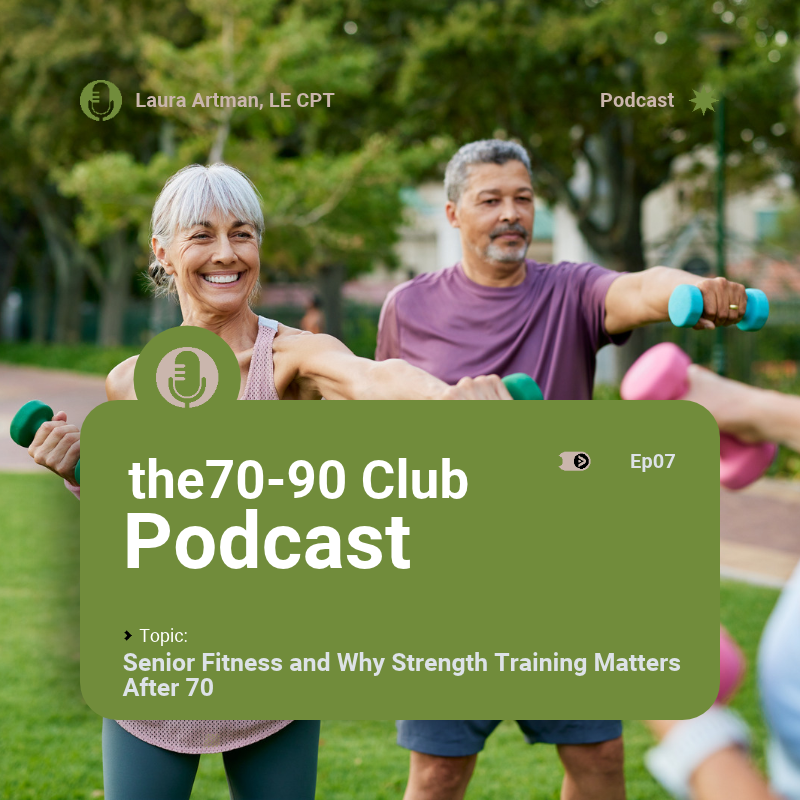
Welcome to the 70–90 Club Podcast. I’m Laura Artman, and today we’re talking about senior fitness and why strength training matters after 70. Senior fitness is sometimes discussed as though getting older automatically means becoming weaker, slower, and less physically capable. But research gives us a more interesting picture.
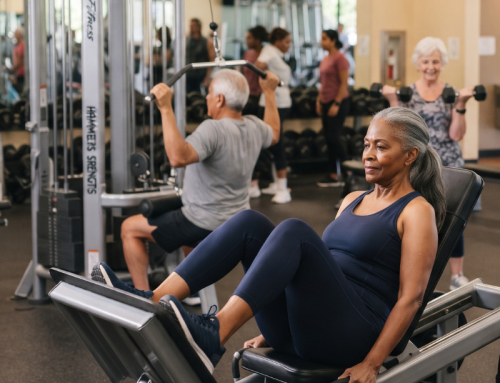
A Harvard Medical School study published in 2004 examined whether women age 70 and older with mobility limitations could improve physical performance through a specific type of resistance training. The study involved 21 community-dwelling women, all age 70 or older, with moderate-to-severe mobility limitations.
Participants exercised three times a week for 12 weeks. The researchers were particularly interested in power. Strength is the ability to produce force. Power is the ability to produce force quickly. That distinction matters because many everyday movements require us to generate force rapidly.
Think about getting up from a chair, climbing a step, changing direction, or reacting when you lose your balance.
The exercise program, called InVEST—Increased Velocity Exercise Specific to Task—used progressive resistance exercises with a high-velocity component.
Participants were instructed to perform the lifting portion of the exercises as quickly as possible while working against resistance. The results are notable. After 12 weeks, the women in the InVEST group improved their leg power by approximately 12% to 36%, depending on the resistance level tested.
The strongest findings were at several higher resistance levels, where improvements were significantly greater than those in the control group. Chair-rise performance also improved substantially. The InVEST group improved by approximately 44%, compared with approximately 29% in the control group. That matters because standing up from a chair is not simply a laboratory measurement. It is a movement people perform every day. The researchers also found an approximately 16% improvement in gait speed in the InVEST group.
The control group did not demonstrate a statistically significant improvement in gait speed. Balance improved within the InVEST group as well, with unilateral-stance time increasing by approximately 50%. But there is an important qualification: the improvement was not significantly greater than the improvement in the control group. That distinction matters when interpreting research. This was a small pilot study involving only 21 women and a 12-week intervention.
It does not mean that every person over 70 will experience the same percentage improvements. It also does not show that this particular program was superior for every measure of physical performance. But the study does provide direct evidence that women in their 70s and older, including women who already had significant mobility limitations, could develop greater physical power and improve functional performance through structured exercise. And that is an important concept in senior fitness.
Aging and physical decline are not interchangeable terms. Aging is biological. Physical capability, however, includes qualities that can be trained. Senior fitness can therefore be about more than maintaining what you already have. It can involve developing strength, developing power, practicing functional movement, and measuring changes in physical performance. The larger lesson from this study is not that older adults should exercise exactly like younger adults.
It is that exercise can be designed around the physical capabilities that actually matter. For senior fitness, that means asking a better question than, “How old are you?” A more useful question may be, “What can your body develop?” This study gives us one clear answer: even after 70, physical capability can remain trainable. Thank you for listening. This is Laura Artman with The 70-90 Club. Join the conversation using hashtag 70-90club. Reach out to ARTMAN STUDIOS Certified Personal Trainer to learn more at artmanstudios.com. Once again, that is artmanstudios.com.
Related Posts








Transcript
Welcome to the 70–90 Club Podcast. I’m Laura Artman, and today we’re talking about senior fitness and why strength training matters after 70. Senior fitness is sometimes discussed as though getting older automatically means becoming weaker, slower, and less physically capable. But research gives us a more interesting picture.
A Harvard Medical School study published in 2004 examined whether women age 70 and older with mobility limitations could improve physical performance through a specific type of resistance training. The study involved 21 community-dwelling women, all age 70 or older, with moderate-to-severe mobility limitations.
Participants exercised three times a week for 12 weeks. The researchers were particularly interested in power. Strength is the ability to produce force. Power is the ability to produce force quickly. That distinction matters because many everyday movements require us to generate force rapidly.
Think about getting up from a chair, climbing a step, changing direction, or reacting when you lose your balance.
The exercise program, called InVEST—Increased Velocity Exercise Specific to Task—used progressive resistance exercises with a high-velocity component.
Participants were instructed to perform the lifting portion of the exercises as quickly as possible while working against resistance. The results are notable. After 12 weeks, the women in the InVEST group improved their leg power by approximately 12% to 36%, depending on the resistance level tested.
The strongest findings were at several higher resistance levels, where improvements were significantly greater than those in the control group. Chair-rise performance also improved substantially. The InVEST group improved by approximately 44%, compared with approximately 29% in the control group. That matters because standing up from a chair is not simply a laboratory measurement. It is a movement people perform every day. The researchers also found an approximately 16% improvement in gait speed in the InVEST group.
The control group did not demonstrate a statistically significant improvement in gait speed. Balance improved within the InVEST group as well, with unilateral-stance time increasing by approximately 50%. But there is an important qualification: the improvement was not significantly greater than the improvement in the control group. That distinction matters when interpreting research. This was a small pilot study involving only 21 women and a 12-week intervention.
It does not mean that every person over 70 will experience the same percentage improvements. It also does not show that this particular program was superior for every measure of physical performance. But the study does provide direct evidence that women in their 70s and older, including women who already had significant mobility limitations, could develop greater physical power and improve functional performance through structured exercise. And that is an important concept in senior fitness.
Aging and physical decline are not interchangeable terms. Aging is biological. Physical capability, however, includes qualities that can be trained. Senior fitness can therefore be about more than maintaining what you already have. It can involve developing strength, developing power, practicing functional movement, and measuring changes in physical performance. The larger lesson from this study is not that older adults should exercise exactly like younger adults.
It is that exercise can be designed around the physical capabilities that actually matter. For senior fitness, that means asking a better question than, “How old are you?” A more useful question may be, “What can your body develop?” This study gives us one clear answer: even after 70, physical capability can remain trainable. Thank you for listening. This is Laura Artman with The 70-90 Club. Join the conversation using hashtag 70-90club. Reach out to ARTMAN STUDIOS Certified Personal Trainer to learn more at artmanstudios.com. Once again, that is artmanstudios.com.